Some reflections on the “Berlin Declaration on Freedom of Expression”
This is the long version of a text I wrote for the magazine “Info3”at their invitation.
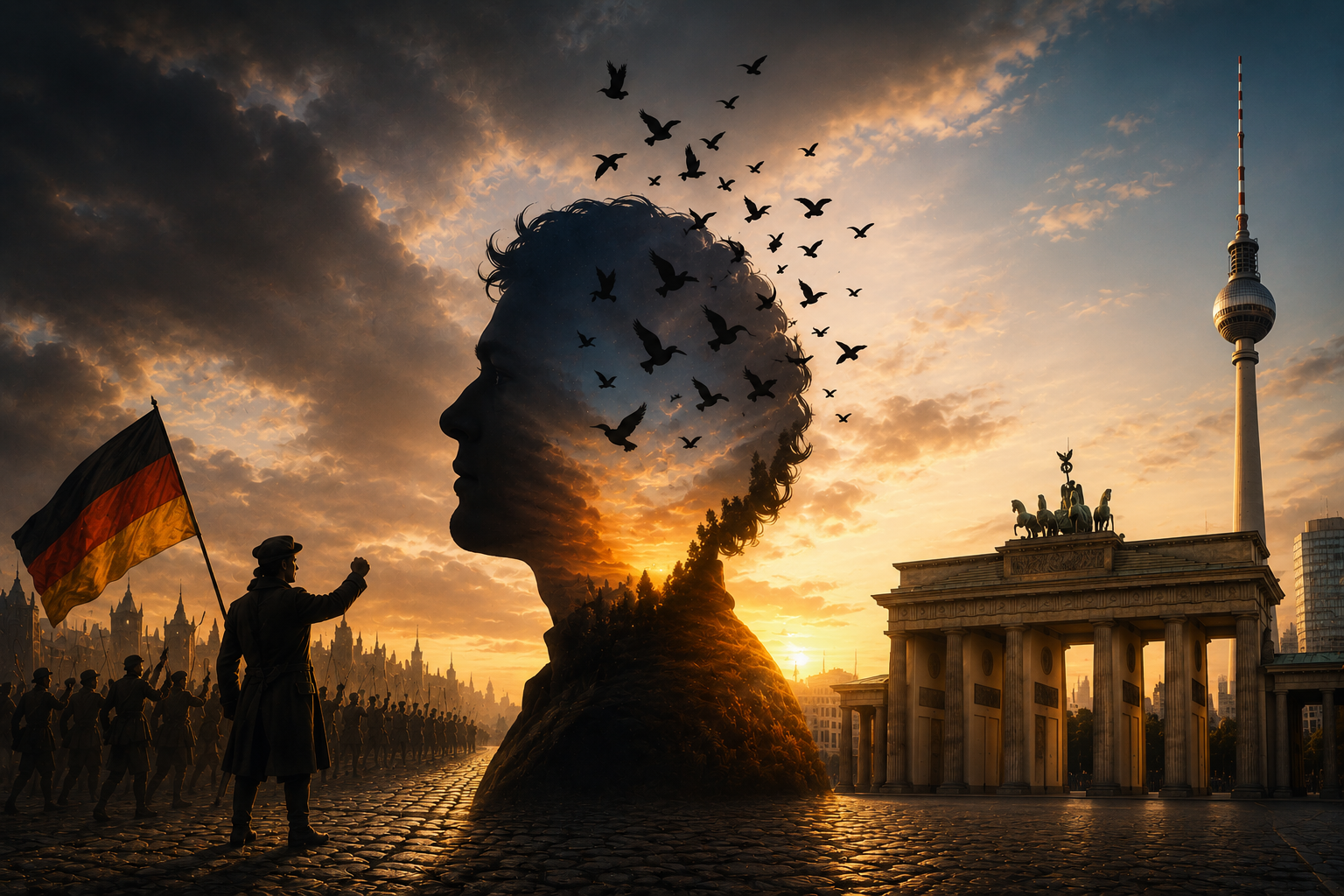
“Thoughts are free, who can guess them? They fly by like nocturnal shadows. No person can know them, no hunter can shoot them with powder and lead: Thoughts are free!” So goes a well-known revolutionary song, which apparently has existed since 1790. When we sang it back then, as teenagers in the 70s and 80s, the content had a somewhat historical-romantic feel to it. Of course thoughts are free. Who could possibly think otherwise? That was our association. And today, 50 years later? Today, there must be an explicit declaration: the “Berlin Declaration on Freedom of Expression”, to remind us of this seemingly forgotten fact. I am one of the early signatories of this declaration. Why is this important? Perhaps a few historical recollections:
Censorship in revolutionary times
When this song was written and sung, censorship was widespread. The state attempted to steer what was published in a direction that could not pose a threat to those in power. The State Chancellor, Prince Metternich, had introduced censorship in the enlightened Habsburg Monarchy of Joseph II to banish revolutionary ideas from France. Even Mozart, who was certainly not overly political, was caught up in it: The musicologist Irmen has demonstrated in a fascinating work [1] that Mozart originally wrote ‘Monostatos’ (loosely: loner, outsider) from Mozart’s ‘The Magic Flute’ as ‘Manostatos’, i.e. with an ‘a’ in the first syllable. The name was apparently changed following the intervention of the censor. For ‘Manostatos’ could be interpreted as a ‘softcock’, as an ‘impotent man’. Irmen assumes that this did not please the censor, either because of the sexual connotation, or because it was seen as an insult to the ‘court Moor’ Angelo Soliman, a black man who was employed at the time as steward to the Prince of Liechtenstein [2].
Censorship naturally also led to harassment, coercive measures, and prison sentences in the revolutionary and post-revolutionary France of the 18th century, which we can no longer—or not yet—imagine today. And we should not forget: the Nazis’ propaganda, their iron grip on everything that was printed and broadcast on the radio or in films, made the nightmare of the Third Reich possible in the first place.
That is also the reason freedom of opinion and, above all, freedom of speech are enshrined in democratic constitutions as fundamental democratic rights. Of course, they have limits: where my freedom restricts the freedoms and personal rights of others. If, through what I say or write, I unduly denigrate others, destroy their reputation, get them into trouble through lies, and ruin their good name, then criminal law applies, specifically the offence of defamation.
So far, the matter seems clear enough, doesn’t it? So why make such a statement now?
Thin-skinned politicians in the age of social media
Well, in recent years we have observed two astonishingly parallel developments: the skin of those in power is getting thinner. I can still remember my youth, when the then CSU chairman and Foreign Minister Strauß—whom I was certainly no friend of—called a female FDP politician and minister a ‘hysterical hen’. He had the audience in stitches. Today, anyone who did something like that would have to reckon with a reprimand, perhaps even a defamation lawsuit. The current frontrunners among the easily offended are Chancellor Friedrich Merz, who filed hundreds of criminal complaints for defamation against various people, and former Economics Minister Robert Habeck, who sued a Youtuber who called him a “dimwit”. This led to proceedings for “incitement of the people” and a fine. He also had a few other lawsuits pending, but given his political expiry date, one would have to send an AI scouring the archives to find them all, which I shall spare us now.
The other, very obvious development is the fact that, thanks to modern social media and the rapid availability of information to everyone, there is an opportunity for anyone to join the discourse. The tone there is not very polite. And because those in power, in particular, are very concerned about their public image, attacks against them naturally quickly become a potential threat to their reputation. In our voyeuristic age, public image—the ‘facade reputation,’ as I’ll call it—is the only currency that counts, measured in the number of ‘followers’ and ‘likes,’ which is the most important thing for all those with a narcissistic sensibility. And if my clinical-psychological instinct is not deceiving me, most people in positions of power are more or less narcissistic by nature. And if you scratch beneath this veneer, people become venomous.
Lèse-majesté and fake news
And what happens? Quickly, an age-old legal offence is reintroduced, one that used to be called “lèse-majesté.” Of course, we don’t say such things in “our enlightened democracy.” We call it “delegitimisation of the state.” And this now allows those in power to deploy state security against supposed “delegitimizers” and “offenders against the state.” And just like that, we’re back in the Metternich era of the 18th century, when people who spoke ill of the emperor or high-ranking figures got into serious trouble. Back then, the emperor, the monarch, or the ruler personally embodied the state, codified in Louis XIV’s classic phrase: “L’état, c’est moi—I am the state.” That is exactly where we have ended up again: the representatives of the state, not only in Russia and the US, behave like monarchs and identify the state with their own person. Anyone who attacks this person attacks the state and must reckon with the full force of the state. To put it another way, we have long since been on a slippery slope from democracy towards a disguised secular monarchy, in which the executive bodies—presidents, chancellors, cabinets—claim personal immunity from criticism. Ultimately, this leads to totalitarian political structures.
Something very dangerous is now emerging from this attitude. Those in power determine what is right and wrong, what can and cannot be said, what is fact and what is fiction, or ‘fake.’ Marx put it well: the dominant words are the words of the rulers. If I represent the state through my stance, my opinions, my limited knowledge, and my values, then anything that stands in opposition to this is, ipso facto, not only wrong and foolish but also threatening and must be eliminated.
This is also why the President of the European Commission, Ursula von der Leyen, described “disinformation and misinformation” in her speech at the Davos WEF Forum in January 2024 as the “most important topic of the Global Risks Report.” The wording there is: “Ladies and gentlemen, dear Klaus, let me return to the most important topic of the Global Risks Report: disinformation and misinformation. Combating them has been a central focus for us since the beginning of my term. With our Digital Services Act, we have established where the responsibility of major internet platforms lies for the content they promote and disseminate…”
You have to listen closely: The most important issue is not wars, not world hunger, not the ecological threat, not even the energy and climate crisis, nor pandemics, nor the economic threat to markets and the monetary system that is constantly being invoked—no: “disinformation.” That is why the EU enacted its Digital Services Act. Ultimately, this is the basis for a massive censorship network. What exactly is “disinformation”? And who decides that? From this perspective, “disinformation” is anything that contradicts the official narrative, regardless of what the issue actually is. Want an example? The official narrative on COVID-19 vaccinations is: They are effective and safe, and everyone should get vaccinated. Dissenting views are no longer simply different opinions. They are dangerous. I don’t even want to discuss who is right here. I have often made my opinion known. I know many colleagues who have been harassed for disagreeing with the majority opinion. Doctors whose practices were shut down, and who have emigrated. Our website “Doctors with a Conscience” documents this with figures. The book “The Courage to Dissent” from our cooperative publishing house “Discorso” [3] contains a series of prominent cases in which dissent from the prevailing opinion has led to severe personal consequences. This process has not only been underway since 2020, but has been creeping in for quite some time. But since the COVID-19 debacle, many people have become aware of it:
Official and unofficial narratives and modern censorship
There is an official narrative on all major issues. This is defined by political leaders and disseminated by “mainstream media” and public broadcasting. Anyone who opposes this narrative is considered to be spreading “misinformation.” And because this is not merely a trivial offense but rather leads to the “delegitimisation of the state” when one does such a thing—since one is thereby attacking the state’s interpretive authority—it is now rapidly becoming a criminal offense.
One need not be a prophet to see where this leads: to a totalitarian, top-down interpretation of the world; of what is right; of who our enemies are; of what citizens should and should not do, say, and keep silent about; and indeed, of what citizens are allowed to think and what they’d better not think.
The Digital Services Act has provided all the building blocks necessary for totalitarian control of speech and opinion:
Our tax dollars are being used to pay for myriads of “fact-checkers,” mostly based in NGOs, sometimes in the press and at agencies. Their job is to expose unwelcome opinions as “fake news.” I have just published a recent case study on how such fact-checkers operate in real time and what is made of it. Such fact-checking services are nothing more than an extension of governments’ power to maintain control over their narratives.
There are “trusted flaggers”: people who patrol the internet and flag content as suspicious so it can be deleted. There are anonymous reporting stations where such unwelcome content can be flagged, active again for the first time during the COVID-19 pandemic.
The people who set up such anonymous smear services have no sense of history whatsoever. Otherwise, they would know that the power of the Spanish Inquisition was based for centuries on the fact that one could anonymously denounce completely blameless people—those one disliked or who had become competitors—for witchcraft or lack of religious conviction. This would then trigger an Inquisition trial, which was often accompanied by the most severe torture and not infrequently ended in the death of the accused. In his biography of the painter Goya, the writer Lion Feuchtwanger described the effectiveness and cruelty of this institution as late as the beginning of the 19th century.
Self-censorship and the necessity of freedom of opinion and expression
But the worst part is the self-censorship that takes root in people’s minds: What am I even allowed to think anymore? Which thoughts endanger my family and me? And in the blink of an eye, the most powerful censorship machine imaginable is installed: voluntary self-censorship. Then, in fact, not even our thoughts are free anymore. And this supposed progress takes us far back beyond the progress reflected in the revolutionary song from 1790—namely, the realization that no censor can take my thoughts away from me if I am not even allowed to speak or write them. Once this mental censorship is firmly in place, there are no dissenting thoughts left at all.
And that is also why this “Berlin Declaration on Freedom of Expression” is so important and why the name isn’t as silly as it seems at first glance. Because it’s not just about being allowed to have our own opinions. It’s about being able to form them in the first place, because we have access to all the information that matters. Because no one is spoon-feeding us which information is actually “good” and “right.” The framers of the Basic Law (German constitution) saw this: Freedom of expression and speech is the foundation of discourse and democracy. It is not consensus and agreement that are the essence of democracy, but dissent, discourse, and the struggle for compromise in a world of conflicting values and opinions. There’s a funny scene in the Monty Python film “Life of Brian,” which is a kind of satirical parody of Jesus’ teachings. In it, Brian says, “You are all individuals!” and everyone nods obediently. Except one. He shouts, “I am not.” It is the contradiction, the dissent, the alternative view of reality—what those in power like to call “fake news” or “conspiracy theories”—that drives discourse and constitutes the essence of democracy. Of course, there are foolish views and theories that are indeed conspiracy theories, that is, theories about improbable causes of events. Most of what is labeled a “conspiracy theory” in the press or other conformist mouthpieces like Wikipedia, however, is simply legitimate criticism of the prevailing narrative. We saw this during the COVID-19 pandemic: yesterday’s conspiracy theory became today’s fact.
A vibrant democracy can withstand such contradictions because people with common sense immediately see that it is highly unlikely we are being remotely controlled by aliens. A democracy that believes it must criminalize such opinions has long since ceased to be one in essence.
And to ensure that our democracy does not become a totalitarian power structure controlled by a few powerful individuals—the “elites,” as we often hear—we must not only retain sovereignty over our opinions and resist self-censorship. We must also preserve the ability to express them freely and must not allow our courage to do so to be bought away.
Read and sign the “Berlin Declaration on Freedom of Expression” and, in between, sing all the verses of “Die Gedanken sind frei …”
Sources and Bibliography
- Irmen H-J. Mozart : Mitglied geheimer Gesellschaften. 1. Aufl. ed. Zülpich: Prisca; 1988.
- Bauer WA, Firla M. Angelo Soliman, der hochfürstliche Mohr : ein exotisches Kapitel Alt-Wien. [Neuausg.] ed. Berlin: edition ost; 1993.
- Stölzle W, Roth G, editors. Mut zum Widerspruch: Dissidenten der Alternativlosigkeit berichten. Basel: Discorso; 2025.